What is the stochastic ensemble interpretation of quantum physics? And is it compatible with the worldview of the authorized version of Law of Attraction (ALA)?
KEYWORDS: consciousness, law of attraction, philosophy of mind, philosophy of physics, philosophy of science, probability-based systems, quantum mechanics, quantum theory, scientific theories.

This article is part of a general survey of the philosophy of quantum mechanics and its relationship to the worldview of the authorized version of Law of Attraction (ALA).
In today’s post I am focusing on an interpretation of quantum theory that is named “the stochastic ensemble interpretation” or, more concisely, “the ensemble interpretation”.
The goal of this article is then to summarize the features of this theory, and to explain what the advantages and drawbacks are, compared to the mainstream Copenhagen interpretation of quantum physics.
Finally, I will discuss the stochastic ensemble interpretation and the authorized version of Law of Attraction: Does the ensemble interpretation do a better job than the standard mainstream Copenhagen interpretation in its theory work, in terms of being more “compatible” with the worldview of ALA?
Contents
- PART 1: THE STOCHASTIC ENSEMBLE INTERPRETATION
- PART 2: DOES THE ENSEMBLE INTERPRETATION WORK?
- 2.1 Only Collective Determinism
- 2.2 A Different Abstraction Level
- PART 3: ENSEMBLES AND LAW OF ATTRACTION
- 3.1 Probabilities and Law of Attraction
- 3.2 The Ensemble Interpretation and ALA
- 3.3 The Copenhagen Interpretation and ALA
- CONCLUSION
- NOTES
- REFERENCES
PART 1: THE STOCHASTIC ENSEMBLE INTERPRETATION
One way to “get around” the Copenhagen interpretation is to remove the focus on individual particles or individual events. This is done by focusing on the idea of “ensembles” — that is, on collections of events. These ensembles are then to be described with some variety of statistical mechanics (Polkinghorne 2002, p. 47). Such an approach was hinted at already by Einstein (Baggott 1992, p. 107; Gribbin 2002, pp. 151-152).
The stochastic ensemble interpretation therefore, approximately, boils down to an attempt to try to avoid the Copenhagen interpretation’s mysterious talk about “the collapse of the wave function” with its accompanying ideas of “superposition” and “wave-particle duality”.
In other words, the stochastic ensemble interpretations are purposely cleaning up the concept space, in order to avoid uncomfortable discussions about the reality of “particles” and “waves” and “superposition”, etc. By doing this, they are presumably trying to “undo” the indeterminism that the Copenhagen interpretation so vividly demonstrates.
So the basic idea is then to look at classical statistical mechanics (e.g., Boltzmann) and try to “copy” some of its concepts and ideas of reasoning, in order to make a more generalized theory (Gibbins 1987, p. 9; Baggott 1992, p. 107). And since classical statistical mechanics is considered to be a deterministic theory, then the stochastic ensemble interpretation should also be determininstic (or so the idea presumably goes).
PART 2: DOES THE ENSEMBLE INTERPRETATION WORK?
As we saw above, one of the motivations of the stochastic ensemble interpretations is to avoid concepts such as “particles” and “waves” and “superposition” and “collapse of the wave function”, etc. That way, such interpretations may be able to “restore” determinism to quantum theory.
But this does not work. Why? Well, as stated above, the idea is to “copy” the general ideas of classical statistical mechanics (which is thought to be deterministic), and to try to generalize those theories in the realm of quantum mechanics. But there are (at least) two problems here: 1) the issue of “only collective determinism”; and 2) the idea of “a different abstraction level”.
Only Collective Determinism
First, classical statistical mechanics in itself is not entirely deterministic, although most physicists want to believe it is. This is because there is no talk about individual particles.
So in a typical scenario using Boltzmann’s statistical mechanics involving gases, we can use various concepts such as “gas pressure” and “entropy” for our calculations (Baggott 1992, p. 107). In other words, it’s a “collective” determinism that is found here, not an “individual” determinism.
Therefore, “collective” determinism is not equal to full determinism. And because of this, there is no scope for anything else than a “collective” determinism for a stochastic ensemble interpretation either.
This means that even if a stochastic ensemble interpretation were to be successfully formulated as some nice generalization of classical statistical mechanics, it would, in principle, still not be able to achieve FULL deterministic status. It would still be indeterministic on the level of the individual “particle”.
A Different Abstraction Level
Another problem is that the “level” of reality that is described with the theories in classical statistical mechanics and quantum mechanics are not the same. In classical statistical mechanics the premise was that there are real, solid atoms and molecules bouncing around in the gas (cf. Dalton’s “billiard ball” model [n1]). So the statistics here would, in such a case, be reducible to (and explainable by) the existence of physically existing particles of various kinds.
However, on the quantum level of reality this is no longer the case. For the quantum level currently is the “bottom” level or layer in the current version of reality postulated by the mainstream physicists. So there is no underlying level of reality on which the quantum level can “lean on”. Therefore, the mainstream view among quantum physicists seems to be that the fundamental quality of the physical world (at least in between measurements and observations) on an atomic and subatomic level is described by probabilities, not by any hard, solid particles.
Consequently, if all the evidence is taken into consideration, a stochastic ensemble interpretation cannot reasonably expect to develop a generalized version of classical statistical mechanics that is fully deterministic, since it would not be reducible to any real particles. In fact, since there seems to be no real, solid, physical particles, there cannot any real ENSEMBLES of real, solid, physical particles either. So not only “individual” determinism is impossible; also “collective” determinism seems to be in jeopardy.
The overall assessment is then that the stochastic ensemble interpretation is, for serious researchers, a no-go theory. Consequently, as Gribbin points out, “the ensemble interpretation is now only of historical interest” (2002, p. 152).
PART 3: ENSEMBLES AND LAW OF ATTRACTION
What can we say about Law of Attraction and the ensemble theory? And how does this relate to the Copenhagen interpretation? To understand that, let us first take a quick look at the worldview of the Law of Attraction.
Probabilities and Law of Attraction
Law of Attraction is an intrinsically probability-based theory. So whether we are talking about the detailed inner workings of “electrons” or “photons” or “cells” or “events”, everything is happening in an enviroment of probabilities. Thus, Seth says (The Unknown Reality, Vol 2, Session 707, p. 292; my square brackets):
“The cells of course are changing. The atoms and molecules within them are always in a state of flux. The CUs [consciousness units] that are within all matter have a memory bank that would far surpass any computer’s. As cellular components, the atoms and molecules, therefore, carry memory of all the forms of which they have been part. At deep levels, the cells are always working with probabilities, and comparing probable actions and developments in the light of genetic information.”
So the electrons, atoms, molecules, and cells are all working with probabilities, just as we are. But because their type of ego-consciousness is less human-like and more animal-like, these consciousnesses have a more immediate connection to the inner workings of the universe than we have. This results in a more fluid and dynamic and spontaneous way of being than most humans allow themselves to be in (The Unknown Reality Vol 2, Session 733, p. 555):
“In your terms, the world is intensely different from one moment to another, with each smallest portion of consciousness choosing its reality from a field of infinite probabilities. Immense calculations, far beyond your conscious decisions as you think of them, are possible only because of the unutterable freedom that resides within minute worlds inside your skull — patterns of interrelationships, counterparts so cunningly woven that each is unique, freewheeling, and involved in an infinite cooperative venture so powerful that the atoms stay in certain forms, and the same stars shine in the sky.”
According to ALA, consciousness (mind, awareness, perception, the ability to think, etc.) is always individualized (hence the expression “conscousness UNIT”). Consciousness is intrinsically a nonphysical thing.
One important feature of nonphysical consciousness is that each consciousness unit has the innate capability to CREATE matter. So, for example, the traces of subatomic particles that the physicists so often see on their photographic plates from their particle accelerators and bubble chambers are the “physical” traces of these nonmaterial consciousness units. As we know from the Seth corpus, these CUs have a “standardized” way of showing themselves (termed “camouflage”) in the physical space-time reality.
The Ensemble Interpretation and ALA
What we have to remember here when we are comparing the ensemble and Copenhagen interpretations is that the ensemble interpretation can be viewed as an “individuality-erasing” theory [n2]. By postulating “ensembles” of events rather than individual events (or individual particles), the ensemble interpretation tries to avoid to explain what is really going on, on the level of the individual events and the individual “particles”.
Therefore, from the point of view of ALA, the stochastic ensemble interpretation of quantum mechanics is not as “serious” about “deep reality” as the Copenhagen interpretation is (and as the authorized version of Law of Attraction also is). In the words of John Polkinghorne, the ensemble interpretation is one of those “minimalist” theories that “is not concerned with gaining understanding of the detailed character of particular physical processes” (2002, p. 47).
The Copenhagen Interpretation and ALA
However, we still have to remember that the mainstream Copenhagen interpretation is not “perfect” either, in terms of its philosophical setup, in comparison with the worldview of ALA. And although its concepts such as “wave-particle duality” and “the superposition principle” might seem puzzling for some scientists and philosophers, the real challenge for quantum theory in general is to realize that nonphysical CUs (consciousness units) are the building blocks of the universe, according to ALA.
In other words, one necessary condition for the state of “completeness” of quantum theory is that individual consciousness units are part of the framework. For if the ontology of All That Is is not postulated as having such units, then there is no chance of ever correctly explaining what is really going on in the physical space-time dimension (although, of course, many faulty, or less accurate, explanations still are possible).
Naturally, one may, of course, take a purely pragmatic, instrumentalist view of quantum physics and say that “we are not interested in anything other than that our equations deliver the right numbers, so that we can predict all the phenomena”. So viewed that way, quantum theory may be considered quite “complete” already now. For it really is excellent in terms of predicting various phenomena.
Nevertheless, most physicists, in my estimation, are not instrumentalists. They are deeply concerned with the inner reality of nature. And when they contemplate the Copenhagen interpretation, they still have many philosophical issues to deal with, including concepts such as “objective reality”, “reductionism”, and “measurement/observation” and its connection to consciousness.
CONCLUSION
The ensemble interpretation may serve those scientists and philosophers who are instrumentalists, and who do not care about what the subatomic world really is all about. So if the main focus is merely how these equations can predict various phenomena on the nanomicroscopic level, or how various methods and inventions may be exploited for commercial applications, then the ensemble interpretation may work just as well as any other theory.
For most scientists and philosophers, though, an instrumentalist stance is not an option [n3]. The stochastic ensemble interpretation is a simplified theory that just does not have anything to offer for a scientist or a philosopher (or a serious student of Law of Attraction) who is committed to investigating the absolute reality of the subatomic world.
In other words, anyone genuinely interested in quantum theory should not spend any quality time trying to master the stochastic ensemble version. A better investment in time would be to go with the standard Copenhagen interpretation (for now), and use various ALA resources to understand the philosophical meaning behind it all.
For example, the importance of the concept of probability in relation to consciousness cannot be overstated. This is highly relevant to quantum theory. Of course, the typical quantum physics student or researcher may, of course, have (severe) reservations in terms of adopting such a way of thinking.
That however, does not change the basic nature of reality: the nonphysical universe of consciousnesses is the ruling realm. Each consciousness has the innate power to create a subjective, “physical” world around himself or herself. All probabilities, on all levels, are explored, in this lifetime and many others, and all experiences contribute to the value fulfillment of each individual consciousness.
Chris Bocay

NOTES
Dalton’s “billiard ball” model [n1] Sometimes Dalton’s “billiard ball” model is compared to one of the atomic theories of the Presocratic Greeks (of which the most influential one was the atomism proposed by Leucippus of Miletus, which was subsequently developed by Democritus of Abdera). However, the Presocratic ideas were not exactly the same as Dalton’s: “Dalton’s theory, for instance, differs from ancient atomism in allowing different elemental substances, and, since the analysis and splitting of the atom, modern “atomic” theory is not an atomic theory at all in the Greek sense, for the word atomon in Greek means indivisible” (Lloyd 1970, p. 45).
the ensemble interpretation . . . as an “individuality-erasing” theory [n2] Compare the conversation between the BBC program host and Professor John Taylor (Mathematics Department, King’s College London): “[Host:] If you abandon any attempt to describe what is going on in an individual system, isn’t that a bit of a cop-out? [Taylor:] Well, I think you have to ask whether indeed you’re in more trouble if you cop-in, than if you cop-out!” (Davies and Brown 1993, p. 110). In other words, the ensemble interpretation is a theory made to avoid trouble, not to explore any ultimate reality (of individual atoms and subatomic “particles”, etc.).
an instrumentalist stance is not an option [n3] An authentic scientist is not content with just trying to “minimize problems”; rather, his goal is to move boldly ahead and actually solve those problems: “[a minimalist view] is abhorrent to the mind of the scientist, whose ambition is to gain the maximum attainable degree of understanding of what is happening in the physical world. To settle for less would be treason of the clerks” (Polkinghorne 2002, p. 47; my square brackets).
REFERENCES
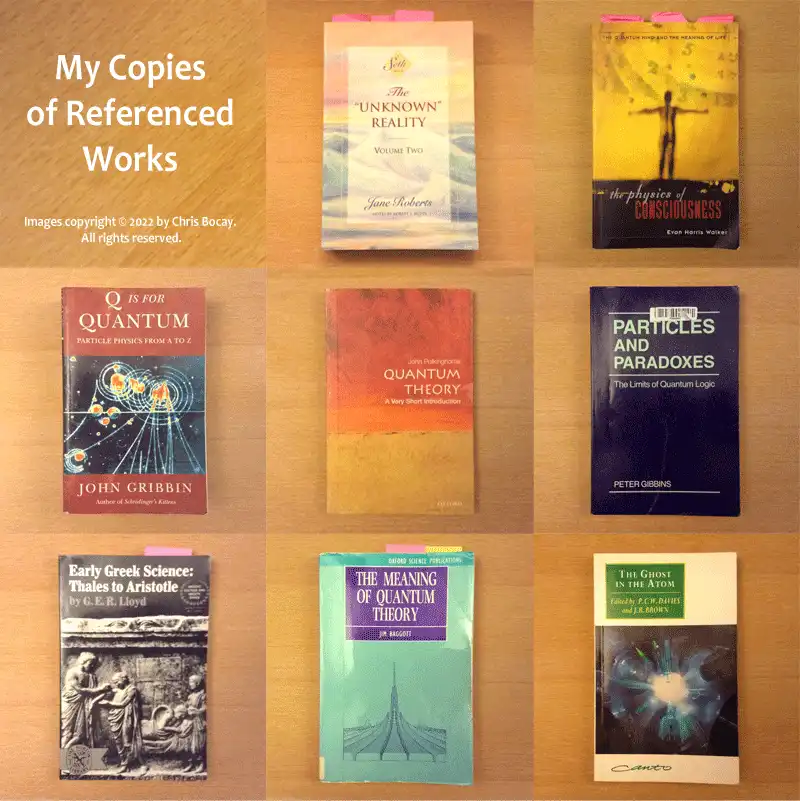
- Baggott, Jim (1992), The Meaning of Quantum Theory: A Guide for Students of Chemistry and Physics. Oxford Science Publications. Oxford: Oxford University Press. [Link to book]
- Davies, P. C. W. (1993), The Ghost in the Atom: A Discussion of the Mysteries of Quantum Physics. Cambridge: Cambridge University Press. [Link to book]
- Gibbins, Peter (1987), Particles and Paradoxes: The Limits of Quantum Logic. Cambridge: Cambridge University Press. [Link to book]
- Gribbin, John (2002) Q Is for Quantum: Particle Physics from A to Z. London: Phoenix Press [Orion Publishing Group Ltd]. [Link to book]
- Lloyd, G. E. R. (1970), Early Greek Science: Thales to Aristotle. Series: Ancient Culture and Society. New York and London: W. W. Norton & Company. [Link to book]
- Polkinghorne, John (2002), Quantum Theory: A Very Short Introduction. Oxford and New York: Oxford University Press. [Link to book]
- Roberts, Jane (1997), The “Unknown” Reality. Volume Two. A Seth Book. Introductory notes, epilogue, notes, and cover art by Robert F. Butts. San Rafael, CA: Amber-Allen Publishing. [Link to book]
- Walker, Evan Harris (2000), The Physics of Consciousness. Cambridge, MA: Perseus Publishing. [Link to book]

Leave a Reply